
The Infinite Tarot:
ABSTRACT
The Infinite Tarot is a tool intended to align with the objectives of psychotherapy, as a way of conducting inward analysis through symbolic association-forming. It expands on and combines various tarot decks into a single framework, as well as integrating several elements of symbolism used in cultural mythos and their many myths.
How seriously should I take the infinite tarot?
As seriously as you any other aspect of magic, and spirituality.
Meaning-making is a very central aspect of human psychological experience. Victor Frankl, in Man’s Search for Meaning, identifies that meaning or conceptualisation can make the difference between suffering through life or finding enjoyment in it. Meaning brings fascination, and curiosity, and drive.
Meaning is also an internal, subjective experience. Epistemology can be thought of as a set of principles by which we arrive at our beliefs, the things we take ‘seriously’. Ontology can be thought of as how we map our beliefs onto things which really exist in the concrete world. For example, we may believe in a particular recurring set of numbers in a mathematical pattern, derived from calculus and deduction. Then we can find an expression or near-expression of that pattern in the physical world. The mapping of the abstract to the concrete is what is meant by ‘meaning’.
This is the same sense in which we can think of magic, and spirituality. Both are forms of abstraction, a set of patterns which exist in the mind without 1-1 mapping to the concrete reality beyond it. When we make a metaphor, and say ‘the expression of this abstract thing is this concrete thing’, we are aggregating, or ‘meaning’, the idea with the reality to bridge the difference between them.
The power of magic, of divining, is in finding beliefs which aggregate well. This can be thought of the project of Tarot, of I Ching, of sympathetic connection. It’s up to you to decide if this is real magic, if it ‘works’. Reality is that which, when you stop believing in it, doesn’t go away. Magic is that which, when you stop believing in it, does go away. The main idea is that belief means ‘something’ is there.
A second caveat, though, is that ‘truth is what is there to be interacted with.’ A lot of magic is unreal, and untrue; enchantment, and illusion, and glamour. Self-deception, or to the magician, deception of others. But where meanings and complex systems of symbols and signs align with reality, where interaction with the interface of magic produces a true result, there is something special to be understood.
The weakness of divinatory systems, the inherent bottleneck on their creativity, is that to create a statement that is true whenever it is called to explain reality, the statement must be exceedingly vague and general, to the extent of creating a tautology.
As examples:
There is someone in your life that is having difficulties.
You have a mentor that you have trusted greatly, but you now find yourself questioning them.
There is a source of innocence that you have lost connection to in recent years.
Change is coming.
The I-Tarot is not wholly different, but because it is dealing with an uncapped number of cards, there is no negotiated tradeoff between generalisation and specialisation. Which is to say, it can attempt to say more things than the typical 78 card tarot deck can.
Combinatorically, even a simple tarot reading can get roughly ~600 000 different outcomes. But, because of sets and suits, those outcomes are often very similar.
Combinatorial uniquenessis not the same as interpretive uniqueness. Many distinct sets map to the same archetypal meaning.
e.g.
Suit of Cups → emotions;
Similar pip numbers → beginnings/ends;
Many different Minor cards can be read as conflict/loss.
A reader compresses thousands of raw combinations into a much smaller set of interpretive narratives.
The dominant axes compress information, cutting through noise for generalised, clear tautologies. The presence of Major Arcana, a dominant suit, and the presence of courts already partition the space into just a few dozen salient buckets.
e.g.
Splitting by (Majors count 0–3) × (court count 0–3) × (orientation pattern 8) gives at most 4 × 4 × 8 = 128 coarse buckets.
Fine distinctions become contextual, and are as much about reading the person as the cards. Two outcomes that differ only by swapping two low-pip cards of the same suit will often be read very similarly, and the same for swaps among related Major Arcana. Conversely, the difference between “No Majors” and “One Major” is usually large in its impact for interpretations.
The card orientation multiplies nuance, but not always meaning. Upright vs reversed can nudge interpretation, but reversed versions of many cards are read as variations on the upright theme (delay, blockage, internalized version), so the semantic distance is usually smaller than a card changing to a different suit or to a Major.
Because of this, and despite superficial complexities, there are unsurpassable drawbacks to finite Tarot.
The I-Tarot is not a claim to ultimate truth, or a hidden pattern guiding everyone’s lives. As a mythos it is not a monomyth, declaring the same set of stories for everyone. If the common fault of cartomancy is combinatoric completeness, or a finite number of plays, then there are a finite number of stories that can play themselves out within the scope of their meaning.
This matters little to the individual person, but like a lottery, readings do not occur on the scale of an individual person. It matters if 800 000 000 people share 600 000 divined fates (based on the idea that 10% of the world have annual tarot readings). The Law of Really Large Numbers, in this case, snips and aggregates awareness in a similar manner to the Rationalisation process outlined by Max Weber in Economy and Society. A deficiency of alternatives creates an iron cage in which different futures become hard to imagine.
I-Tarot aims to surpass this by replacing fixity with infinity. New sets will emerge, connections be mapped and drawn, as a continual, growing story plays out across the cards, mixed with meaning drawn from living, evolving cultures.
ORGANISATION
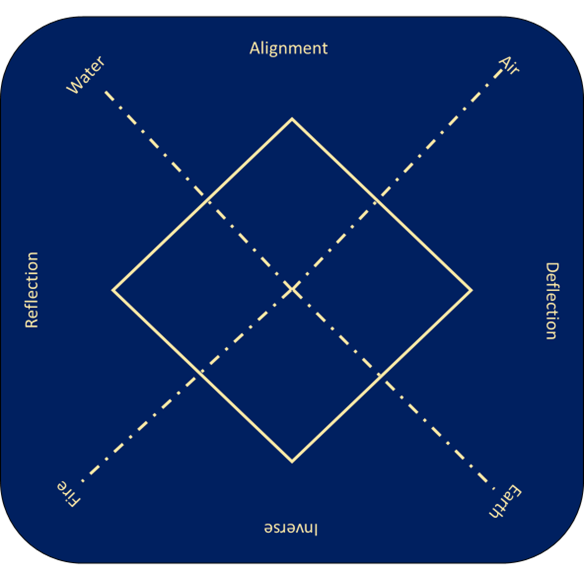
I-Tarot does still employ sets, suits, and arcs, though there in no insistance that they define the card, or are the ‘main’ feature of it applicable when called. It uses a basic framework of degrees on a Spread as a means of ‘uncovering’ hidden relationships or implications:
Domains:
Starting at the rightmost point of 0°, there are 360° points, as well as decimal fractions, from which to initially organise Tarot cards by themes and subthemes. The four basic Domains are:
Deflection:
Domain of unawareness, games, toys, childhood, fantasy. Diversion and entertainment, distraction and illusion.
Alignment:
Domain of goals, targets, achievements, victories. Action and attainment.
Reflection:
Domain of thought, contemplation, clarity, sense-making. Learning and insight.
Inversion:
Domain of setbacks, obstacles, withdrawal, hinderance. Enemies and obfustications.
These Domains are very loose thematic interpretations, subdivided into blended zones, such as Reflection-Alignment and Reflection-Inversion. Sub-Zones may specify even more precise patterns, such as locals, ‘worlds’ of experience, or F-Suits (explained below).
Elements
In addition to the domain axis, the 45°-135°-225°-315° degree lines divides the circle by Element. The four elements, Air (45°), Water (135°), Fire (225°) and Earth (315°), lend an aspect of energy to the reading, and are invoked when a Reading involves Transitives.
Transitives are changes from one card to another of the same aspect. For example, a Figure card may begin in one state, transfigure through the process of a Reading, and then emerge as a new figure at the end of the Reading. Elements in these sorts of Readings, describe a shift in essential nature, or in the expression of a stable nature. Where they relate to Forms and Fixtures, they can describe a journey that is taking place.
The importance assigned to Element depends on the individual reading, and the F-Suits undergoing transition. They may:
Transfigure
Transform
Transfix
Transfate (or transLate)
Transfocus (or transFER)
Elementally, there are 16 ways we can conceive of transitives occuring. As an example:
Water -> Air Changing element from flow and reflection to lightness, dispersal.
Water -> Earth Changing element from flow and reflection to solution, hardening.
Water -> Fire Changing element from flow and reflection to melting, agitation.
Water -> Water Sustaining element from flow and reflection to a similar nature.
ASPECTS
Aspects are significant within the I-Tarot. There is no distinct separation of Major or Minor Arcana. Some card lend themselves to more familiar / recogniseable narratives in combination, but each alone is also central and important to a Reading.
Instead, aspects are divided into F-Suits. These are designations of what is being depicted:
Figures are personas, characters or roles played by people in the world. They may indicate an aspect of how the participant is behaving, or how a person in their sphere behaves. More abstractly, they can reflect the behaviour of intelligent systems, like bureaucracies or cultures.
Forms are landscapes or environments, the surrounding circumstances or setting in which the situation is playing itself out. This exercises its own energy and control, and can be significant to how an event plays out. They can indicate a journey or voyage to a state of mind or awareness.
Fixtures are inevitabilities, immovable realities that need to be taken into consideration when navigating situations, like mountains or monuments. Fixtures can be obstacles in the path, or sources of power, or opportunities for renewal.
Fates are courses of action, describing what occurs between the cards in the Reading. Fates can move or change according to what they influence, do not always lead to the same outcome, but rather describe the current or flow of gestalt intention, the way things are being ‘pushed’ by the greater motion of the universe.
Focuses are an alignment of mental effort, objectives or ideas that are guiding or holding the attention of the cards. They can represent intentions, or frustrations, or fascinations. They may be aligned to goals or be a distraction from them, and interplay importantly with fates when deciding upon their significance.
The F-Suits provide a spread for the standard 5-card Reading of the I-Tarot. When a card is placed on a spread, it is drawn at an angle reflecting the participant’s input, which may be the placement of their finger (such as on a touch screen), cursor, or more old school, a ‘yarrow stick’ placed in the centre of the board and allowed to fall. Changes in direction offer additional layers of symbolic meaning. Simpler, of course, is drawing a card from a shuffled deck. Decks can be divided by F-Suit to ensure a card of the correct aspect is drawn.
Kinds of Readings
There are many ways to Read. Some are more involved than others, some are a quick guide or reflection on a situation. All intend to introduce an element of randomness into selection.
Randomness can be thought of as surrendering control to chaotic forces, to a higher power or gestalt, or simply dealing with unpredictable input to see how the system compensates and anneals.
There are more traditional, simple Readings that are straightforward Drawings. More complicated ones involve mathematics and numerology, calculating the angle of a new card by finding the intersection of it and older cards. This numerological Drawing is part of how the Infinite Tarot is generated.
1-Card Reading:
These Readings convert an angle on a Spread into a single card. They can serve as a grounding within the I-Tarot, the discovery of an identity or naming of a situation.
Finding a card in the wild is a 1-Card Reading. It is an overture, a means of inviting others to play The Game at Hand.
2-Card: These readings convert the angle of a card on a spread into a new card in a different spread.
• 3-Card: These readings convert the averaged angles of 2 cards on a spread into a new card on a 3rd spread.
• 4-Card: These readings convert the averaged angles of 3 cards on a spread into a new card on a 4th spread.
• 5-Card: These readings convert the averaged angles of 4 cards on a spread into a new card on a 5th spread.
• Readings should be upgradeable. When a 2-card reading has been performed, a new spread can be introduced to upgrade it to a 3-Card Reading.
Trans-Spreads
There can only be one Focus and Fate present in a reading at a time. Forms, Fixtures, and Figures may have two of each present at a time. These Trans spreads permit the idea of symbolic changes from one state to another. Through transitivity, Fate and Focus may be reinterpreted.