
PRANA-BINDU
~ My mind affects my reality ~
My reality affects my mind ~
Ashby’s Law of Requisite Variety:
“A system can only regulate disturbances if its range of actions ≥ the variety of those disturbances.”
Ross Ashby

Abstract
Polyvagal Theory identifies three main ‘activation profiles’ associated with feedback from the peripheral nervous system. These profiles are seen as ‘modes’ that describe organ and muscle function and how they change to achieve context-specific objectives.
Mobilization: Fight-Flight Mainly Sympathetic Nervous System
Socialization: Rest-Digest Mainly Parasympathetic Nervous System
Immobilization: Freeze-Flop Mainly Dorsal Vagal System
These three modes imply a total of 6 1-directional pathways from one state to another, as well as 3 static pathways used to maintain a single state. In line with Ashby’s Law of Requisite Variety, 9 control behaviours are necessary to fully ensure the ability to move between these states:
Mobilization → Mobilization
Mobilization → Socialization
Mobilization → Immobilization
Socialization → Immobilization
Socialization → Socialization
Socialization → Mobilization
Immobilization → Immobilization
Immobilization → Mobilization
Immobilization → Socialization
In general, when we are thinking about nerve feedback we think of regulatory exercises informally, as tools which may work for some people but not for others. We may apply ‘breathing exercises’ or ‘relaxation techniques’ without any conscious deliberation over what mode we are in, or which we are hoping to enter.
Appropriate control systems consider the:
1. Initial State,
and
2. End State
as critically important to selecting the type of technique that is likely to have the greatest positive effect.
We can cross-classify each path further by its channel, the targeted mechanism within the nervous system:
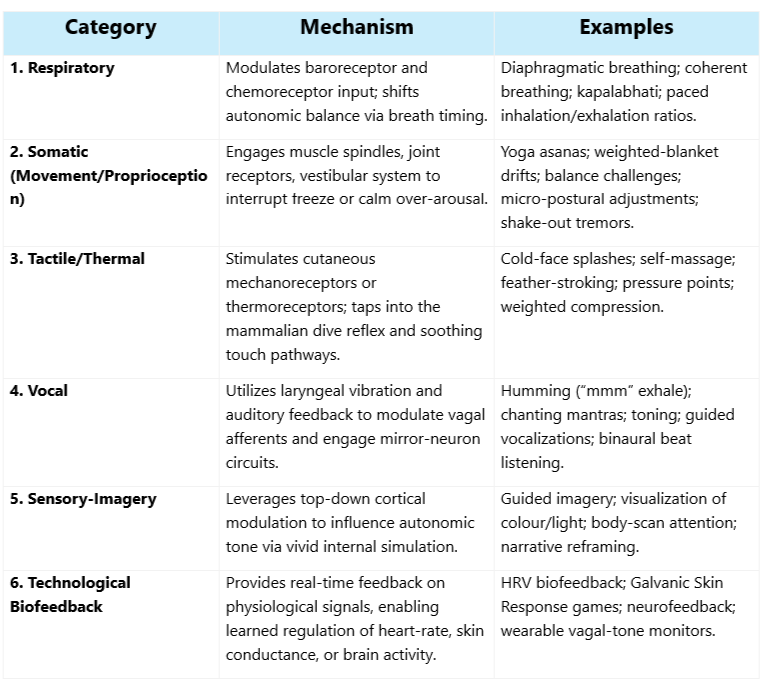
For maximum effectiveness, a technique may be further extended to a ‘form’, categorically aligning with five of the six channels (as technological biofeedback is difficult to acquire), giving exercises designed to transition from one state to another with a finer degree of success.
Systemic Continuum:
As a further consideration, the 3 modes or ‘profiles’ could be regarded as non-binary, involving a degree of categorical overlap that creates 4 more states:
Mobilization + Socialization = Integration
Mobilization + Immobilization = Agitation
Socialization + Immobilization = Tranquillity
Immobilization + Mobilization + Socialization = Ecstasy
This brings the total number of control pathways to 49, consisting of 7 base states, 42 one-way triggers to a different state, and 7 paths to maintain a current state:
Base:
Mobilization → Mobilization
Mobilization → Socialization
Mobilization → Immobilization
Socialization → Immobilization
Socialization → Socialization
Socialization → Mobilization
Immobilization → Immobilization
Immobilization → Mobilization
Immobilization → Socialization
Extended:
Mobilization → Integration
Mobilization → Agitation
Mobilization → Tranquillity
Mobilization → Ecstasy
Socialization → Integration
Socialization → Agitation
Socialization → Tranquillity
Socialization → Ecstasy
Immobilization → Integration
Immobilization → Agitation
Immobilization → Tranquillity
Immobilization → Ecstasy
Integration → Integration
Integration → Mobilization
Integration → Socialization
Integration → Immobilization
Integration → Agitation
Integration → Tranquillity
Integration → Ecstasy
Agitation → Integration
Agitation → Mobilization
Agitation → Socialization
Agitation → Immobilization
Agitation → Agitation
Agitation → Tranquillity
Agitation → Ecstasy
Tranquillity → Integration
Tranquillity → Mobilization
Tranquillity → Socialization
Tranquillity → Immobilization
Tranquillity → Agitation
Tranquillity → Tranquillity
Tranquillity → Ecstasy
Ecstasy → Integration
Ecstasy → Mobilization
Ecstasy → Socialization
Ecstasy → Immobilization
Ecstasy → Agitation
Ecstasy → Tranquillity
Ecstasy → Ecstasy