
Life Planning
‘Life’ in the context of Legacy of Mind is a multigenerational projection of values beyond an immediate physical embodiment into an extensive future. This is important when understanding aims, as they may not always be about success within a human lifetime, but form a pattern of success expansively across a minded ecology.
That said, the immediate bounds of physical embodiment are worth considering as a localized context for action. The prime concern with such a life plan is admitting the limits of knowledge, expressible as chaos, and how one prepares for movement through what is anticipated to be a chaotic and complex system.

Convergency vs. Contingency Planning
The chief concern with plans has to do with Etiology, or what can definitively be said about relationships of cause and effect. Planning typically involves a conjecture of understanding cause and effect to the degree that what one does now will reliably lead to something happening later.
Convergencies are events with multiple independent causes that all lead to the same effect. This is an ‘all roads lead to Rome’ view, that there is a wider pattern behind things shaping them to a single, predetermined future point or destiny. The opposite, Divergencies, describe the condition where the same cause can lead to multiple different effects.
Contingencies are events where even slight changes in causal conditions leads to very different effects, in a sense being in Rome and selecting one fork in a road that leads to London or to Beijing. They can be thought of as the dependencies between causes, or the sensitivity of effects to decisions.
The opposite of contingency is independence/insensitivity, in which choices do not matter because they don’t have a significant impact on how events play out.

Contingency and Convergency are not perfect opposites, but rather are orthogonal variables in planning. They present baseline assumptions about the nature of causation-in-context which lead to very different strategies:
If the assumption is that the cause is convergent, immediate choices matter less because the event will happen anyway. There is more freedom in which goals one selects, and how one does things, because ultimately everything will bear down on the same point anyway. Plans do not need to be detailed and less effort is made to figure out how things are going to happen. However, it may be that big choices matter, describing points of crisis between a small number of possible futures.
If the assumption is that the cause is contingent, even very slight differences in how something is accomplished will create radical and unpredictable effects. There is less freedom in choosing goals or how to go about achieving things, because even slight choices will make large differences. Planning must be careful; effort needs to be placed into understanding possible consequences. Fungibility becomes important as a means of correcting course when things go unexpectedly, because in a contingent domain follow-up choices may reverse or course correct a plan.
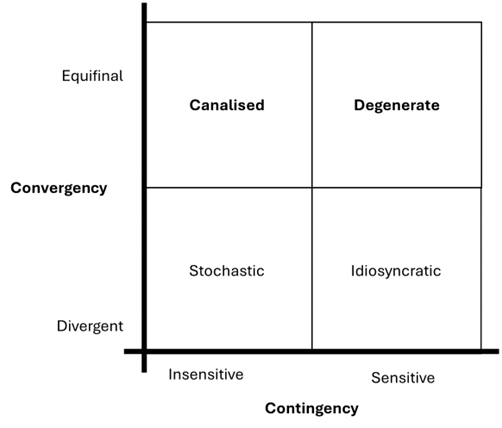

Because these properties are orthogonal rather than oppositional, they can be described by four combinations:
Stochastic:
Events happen at random, diverging and not seemingly related to what a person does. Effectively, planning is pointless.
Degenerate:
Events follow a tense interplay sensitive to individual decisions, but ultimately bent toward fixed points of crisis on the macro scale. Choices occur but can be illusionary, shaped by forces outside of the one planning the course. Predictions are possible, and shape one’s decisions toward inevitable conclusions. The outcome of decisions is heavily dependent on distributed group choices, and consensus.
Canalised:
Choices are insensitive to individual expression, and converge on fixed points. It may not matter what a person does because they are in the hands of destiny, but they can predict what will happen and so align themselves with greater forces through prediction. Branching canals may mean that there are big, critical decisions (crises) that shape the future into a small number of possibilities.
Idiosyncratic:
Paths are sensitive to individual choices and specifics, and can lead to many different possible outcomes. Prediction is extremely difficult, and there are few global principles guiding the course of history. One person making a choice at the right time can change the course of history, but the choice can be subtle and sometimes it is impossible to predict what it will achieve.
These four zones can be considered as planning paradigms, or planning contexts that apply to specific situations or etiological domains. Before any planning can be considered meaningful, the domain must first be correctly calibrated.

The nature of these paradigms also suggests that the cultivation of Legacy of Mind should focus planning in ways:
What is Degenerate should be considered as a desired outcome, what is going to happen anyway a person should try to understand, so they can consent to it and even want it to occur. Effort should be made to bend to the process, to become part of it, or an observer of it, without feeling the need to control it. Participation is not necessary, but it can smooth the process and so should be considered as good and intentional.
What is Canalised should also be carefully considered a desired outcome, as a likely inevitability. However, one should be careful to study in case effort or push can ‘break’ canals, as they may be points of crisis with strong binaries. Cyclical events may also move ‘slowly’ or ‘quickly’, and the benefits of frustrating efforts to move events slowly, and intending events to help them move ‘quickly’, are a worthy consideration.
What is Idiosyncratic should be treated with caution, emphasis should be on conserving resources and preparing for shocks to the system. The unpredictability of systems necessitates contingency plans, where you predict that your plans will fail to successfully navigate the systems around you.
What is Stochastic should be treated with extreme caution, emphasis should be on conserving resources, preparing for shocks to the system, weathering the storm, and increasing efforts to observe and understand what is happening. In times of internal chaos, internal calm and routine need to be cultivated so that when the moment comes to get out of the situation, you are properly prepared.

Goal Classification
Understandably the Contingency-Convergency relationship is continuous rather than discrete, so classification is ‘by degree’ in one or more categories. There are guidelines that best describe which paradigm applies to the evaluation of different goals:
Goal Impact:
This describes how sensitive reality is to you achieving your goals, such as whether things will be changed by them a lot or just a little through dependencies.
High Impact favours canalized and idiosyncratic pathways, divided between them due to potential for predictability.
If a goal is high impact but unpredictable, it will likely disrupt the status quo, which may be a good in itself.
If a goal is high impact and predictable in outcome, it is perfectly positioned for greater exploration.
Cost & Risk
Decision Cost is reflected in a decision’s ‘buy in’, and in a decision’s Risk. Risk is the more easily quantifiable as susceptibility to divergence, reflected in idiosyncratic and stochastic paradigms. It is generally best to deprioritize high risk goals, because they can be more easily frustrated. However, reward can still outweigh risk, and as much of cause is divergent it is important to explore this area through expected value calculations.
Cost can be thought of as upfront risk, usually what is traded is some lowering of the status quo with the chance of getting nothing back, though it is important to recognize cost as decoupled from risk (you can pay a cost and still have divergent outcomes).
Costs are a normal investment in process, but it is still worth looking at whether pursuing a goal makes you better or worse off than before. Many decisions will rather obviously act against your values. Opportunity costs occur when making decisions that take time and energy to pursue an effect, and the effect may not ultimately align with your values either.
Freerolls are decisions that reflect low risk, low cost, and as goals are generally good to have. These can be goals like ‘taking the time to enjoy the moment’ or ‘tidying up as you go from one place to another’.
Generalizable cost and risk are something that you must pay no matter what decision you are making, so while it can affect how we think about decisions, an effort should be made to treat the goal as a freeroll if there is high divergence to the decision.
Slime-Mouldy Decisions
These reflect goal parallelization, and describe contingency plans. When values that achieve multiple goals can be taken in concert, it is generally a good idea to do so rather than approaching things one at a time – provided it is clear they don’t interfere with one another, as this will cause frustration.
Much like the exploratory adaptations of slime moulds themselves, these decisions work under a paradigm of stochastic/idiosyncratic planning, where contingent probes into the unknown are made along paths that ‘branch’ as they navigate new territory.
Quittability
Quittability or Reversibility describes an attribute of decisions or goals in which they can be ‘unchosen’ or reversed if they are not producing the desired result, or seem unlikely to pan out. This is an aspect of sensitivity in line with high contingency, and so tends to describe idiosyncratic and degenerative spaces. In the idiosyncratic it can be a sign of wavering, or a steady hand guiding a highly random process; in the degenerative it can reflect conditions where it is easy to initially go the wrong way before converging on a solution.
Decision Stacking
A function of convergency, in which larger effects are reduced to a less complex system of smaller goals and decisions. By stacking decisions in this way, something large and complex can be achieved by first going after the smaller and more achievable goals that precede it. In this way, the costs of a decision can be controlled and monitored by performing low cost contributing elements first, then proceeding through to the full thing.
As it deals with convergency, it tends to reflect in the canalized and degenerative paradigms.
Monster Decisions
These are very impactful, costly, risky, and unquittable goals which, once sought, require diligence and careful planning to achieve. Because of this, they are virtually impossible to achieve (intentionally) in the domain of stochastic or idiosyncratic events; only canalized and degenerative paradigms allow them. In degenerative paradigms there is little freedom to manoeuvre, and behaviour becomes simply ‘carrying out the plan’. In canalized ones, extreme crises that are difficult to navigate require considerable planning to accomplish.

ORDERED PLANNING
The Orders of Legacy of Mind also lend themselves to a loose association with planning paradigms:
1st Order Values:
Degenerate. As ‘guiding principles’, these are the sorts of small-scale decisions which guide an objective even if the context in which they apply is very different. In the physical world, this serves as a ‘domain of control’. Provided you acknowledge that you can choose the cause, but must accept its effect, you are in complete control of these sorts of ‘plans’.
Incidentally, if you choose different values to those that succeed in the end, the result is simply frustration of your goals, not your ultimate success.
2nd Order Ethics:
Canalised/Idiosyncratic. Generally these are points of failure in planning, where a semblance of order can be disrupted by stark failures to see the importance of small things in their context. The danger of ambiguity in this area leads to feelings of agency where none exists, and a lack of agency where it feels like it does exist.
Preferred Indifference can sometimes be used as a guide, to state preferences while knowing that they rely on uncontrollable externals.
Planning in this area also includes goal setting and missions, identifying objectives and working toward them, mindful that they ‘may’ be canalized, but also may later turn out to be idiosyncratic. To prematurely dismiss something as one or the other is erroneous.
Skills development or Performance Targets fall within this category, the ‘canal’ being pass/fail criteria. You can show up and be present for regular practice, but sometimes fate (fortuna) will act against you.
3rd Order Morals:
Because multiple decisionmakers are involved, the dominant paradigm here is typically stochastic/idiosyncratic, though possibly with long-term degenerative features. It is frustrating to pursue precise goals in a domain of counterwill, where others’ willingness to go along with your goals ultimately decides their success.
Goals in this area are typically observational or experiential; to witness or be a part of something bigger which is ultimately outside of your control. Despite your efforts a situation may degenerate in favour of a different goal, and because you were one person in a cohort of decisionmakers, the impact of your actions can be overcome by the impact of everyone else’s.
What this effectively means is that, from the perspective of Legacy of Mind, ordered planning aims to avoid forcing the way, or remaining open to changes while remaining clear on values.
Planning to Fail
Contingency planning, or planning to fail, plays a significant role in the humility of uncertainty. When planning to fail, you pursue fungible causes, which is to say variable resources that contribute to several possible desirable effects. This can include:
· Skills
· Experience
· Money
· Tools
· Connections
While simultaneously avoiding the accumulation of frustraters:
· Enemies
· Debts
· Overhead
· Responsibilities
This means that even when a single goal fails, the adaptive basis toward making future decisions accumulates over time.
The idea of contingency planning in LoM is to aim for flexibility, being unattached to specific outcomes, while remaining firm on principles. In this sort of planning flexibility is built first, relations are established tentatively, and are allowed to change when situations change.
It should be noted that all relationships are in effect laws, and so the more of them there are, the more constrained a person becomes in the expression of their intentions. Factoring in counterwill, maintaining bad bonds, relations, debts, and laws impacts the achievement of one’s values, so the ability to flexibly alter relations is pivotal to the attainment of values.