Legacy of Mind
A LIFE MISSION STATEMENT
Background
In 2024, lacking a feeling of direction and an ambivalent pull toward different spheres of self-expression, I had a therapeutic session with ChatGPT to explain my feelings to it and gain some perspective. This was largely in terms of my not having time to pursue everything; that self-education, discovery, sociality, intimacy, work, and creativeness were perhaps not universally compatible goals, because energy and time invested in one area necessarily detracted from the other areas.
Its response was to identify a common thread winding through the different areas of my life, and set a new goal/objective separate from excellence or achievement in any one area. This common thread, or Legacy of Mind, is to apply my learning and life principles as a discipline, and focus on achieving the discipline rather than measuring achievement as extraordinary success in any one area. This suggestion spoke to me, so I kept the phrase ‘Legacy of Mind’ as a reminder of the ultimate objective resting behind proximate actions.

The FIRST ORDER
A VALUE SYSTEM
Values can be thought of as conditions which are seen to be desirable when increased or otherwise when maintained at a specified level.
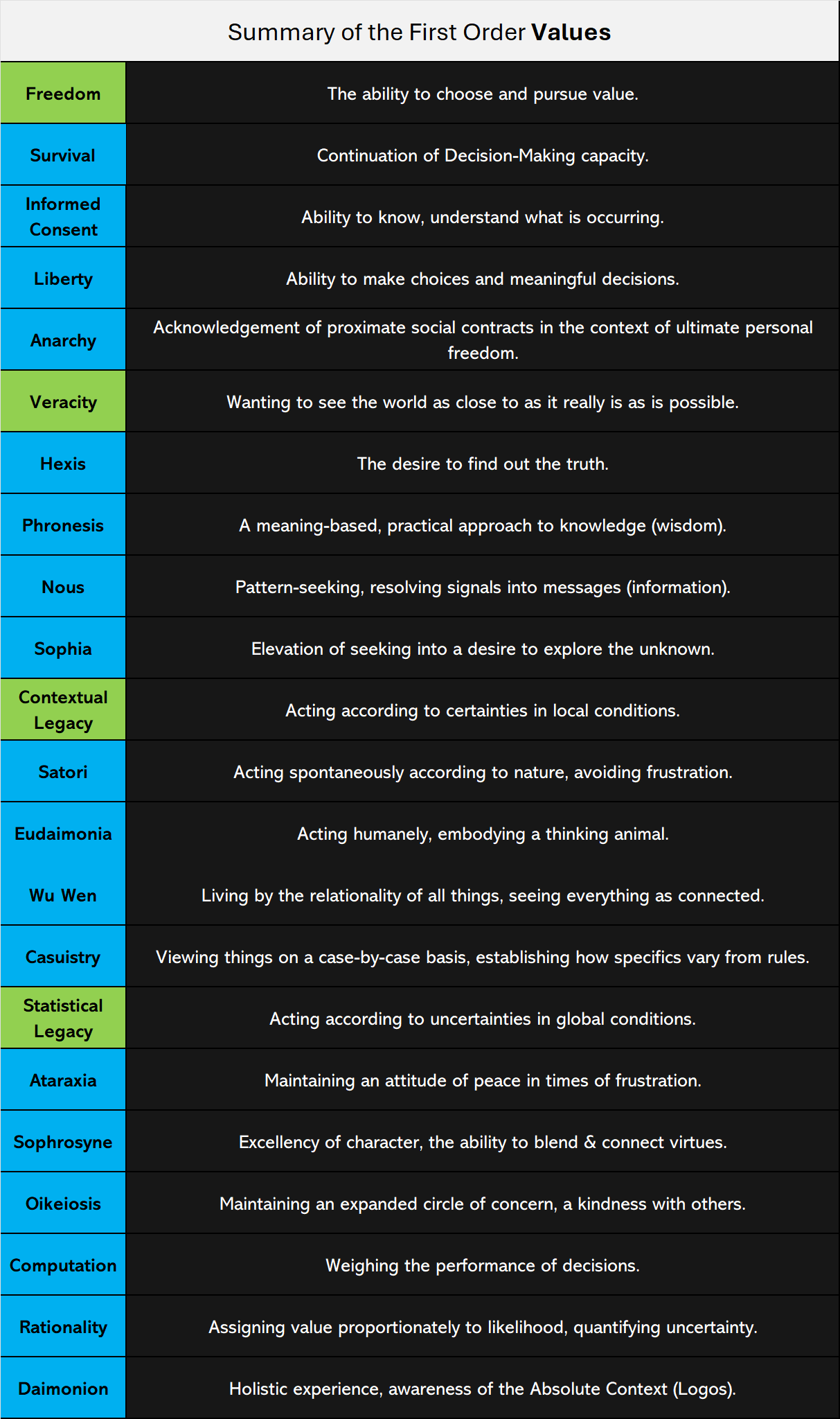
My stated values are:
I. FREEDOM: The prerequisite ability to choose and pursue value.
- Physical survival, to the extent that physical survival promotes the survival of mental/spiritual values thus identified.
This can be subdivided into:
- Informed Consent; knowledge and freedom in making choices.
- Personal Liberty; The ability to move away from pain and toward pleasure, to be free from ownership, and to declare one’s own debts.
- Political Anarchy; Recognising the ultimate basis of free will in all instances of social contract, even those which, in expression of contract, do not resemble lawlessness.
II. VERACITY: The disposition to want to see the world as close to as it really is as is possible.
Practically as important as ‘choice’ and ‘pursuit’ of value, the two are strongly connected. A person must know a thing as it is to have informed consent to it as a value, and must have liberty to select the value, as knowing what it is without the ability to pursue it is meaningless. This can be subdivided into:
- Hexis: A disposition to truth-seeking
- Phronesis: The cultivation of practical wisdom, such as self-knowledge and how to be happy.
- Nous: An intuition or pattern-finding ability in relation to the truth.
- Sophia: Wisdom through understanding science and pursuing discovery.
III. ARTISTRY: Using the remainder of my power to shape the world into what I conceive of as beautiful to me.
o Many areas of ‘beauty’ or ‘aesthetic’ are efficiently achieved by the expression of I and II, but it is important to distinguish beauty as a tertiary concern, because while it is still valued it is likely that if I find something ugly but must accept it is true or necessary, some other aspect of my understanding is likely at odds, my values are out of alignment.
It may also be the case that there is simply room for aesthetic choices once all other things have been accounted for, and in these cases, where beauty can exist it ‘should’ exist.

The principle of Legacy of Mind rests on a discipline of these desires around their relationship to subjective mortality.
We can say that reality proceeds, as we view it, according to time’s arrow, as a process from one form to another, even without explicitly stating the process has a beginning or end. As we move along in the direction of time’s arrow there are events, which we call effects because they have a special relationship with the preceding events, called causes.
In the lifetime or subjective mortality of a single person, they contribute to any number of events, and play a part in causing later events. When the events they cause lead to the effects they desire, we say they fulfilled an intention. Because people can project their desires on the future, beyond their lifetimes, they can pursue events with the intention of creating the world they desire, and feel pleasure in doing so, and pain at the frustration or unintended consequences of the events they create.
Frustration occurs from intentions running contrary to the mechanics of reality, or contrary to the intentions of others, who exert counterforce by pursuing events that cancel out the events of others. Frustration can be thought of as a form of pain. Consequently, to exercise personal liberty one must minimise frustration, in part by understanding the mechanics of reality, and in part by understanding the intentions of others and how they may frustrate one’s aims.
Particularly, it is also important to understand when your intentions are shared by others. Progress can be made when more people share intentions acting in accordance with the mechanics of reality than there are people and events that frustrate them.
This notion pairs subjective mortality with objective/collective immortality; that other people and mechanics of reality acting in accordance with your intention is effectively an extension of, or an expression of, the values you hold.
If your mind could be thought of as a decision procedure with the intention of optimizing its values, then the subjective, mortal self becomes secondary to ensuring that the correct values are known and procedurally caused by a collective, or by the mechanics of reality. (Legacy)]]]]

Unprincipled, this does of course sound like a recipe for domination and assimilation. Value misalignment occurs:
When notions of beauty are put ahead of the desire to know what is real.
When a person assumes or sees themselves as the authority on what is real.
When the mechanics of reality are believed subservient to collective belief to the extent that there is no objective reality outside of the collective.
The belief that one’s own personal liberty matters, without recognizing the frustration that will occur when denying the liberty of others.
The expression of these misalignments to leave a legacy are in line with making others think like themselves. These misalignments occur when one or another of the stated virtues is radicalized to the extent that it interferes with others, or does not otherwise follow through on its entailments when applied to real contexts. It may go without saying that value misalignment is bad, and should not be considered as a correct expression of Legacy of Mind.
When kept into alignment with truth-seeking, and with the principle that others must be accorded liberty, that is to say when others are viewed not as tools but as Minds, there is accorded an opposite principle: to identify what the mechanics of reality are and align with them, and then to identify what collective intentions are aligned with reality, and participate in them. The Legacy of Mind is not to impose anything, but rather to identify what necessary effects transpire from current causes and understand them well enough to consent to them as intentional, so that a life of frustration of one’s values can be avoided.
A secondary consequence of this course of action is a form of ego-death-without-ego-death, that is to say not to seek the spontaneous or intentional end of selfdom, but to arrive at it through casual acceptance that what matters is more important than what one is.

The Distribution of Events
Events happen all along the arrow of time. Cause and effect describe the passage of time and ‘clusters’ within the pattern that suggest some events are more closely related than others. In terms of whether an effect occurs, events exist in a distribution, either promoting a causal situation or demoting it, which all together create a central tendency. Correct prediction of the central tendency in specific or general contexts is a key aspect of understanding the mechanics of reality.
If one can accurately predict what is to occur, participate in events and declare the outcome intentional, then the central tendency becomes a legacy of mind. In other words, if your mind is shaped to model reality as closely as it can, and mirrors the mechanics of reality, then the continuation of reality itself becomes as though the mind-as-model continues to exist. Teaching yourself to want to see things as they are in reality becomes identical to consenting to reality. This is not the same as ‘wanting things as they are’, but more about acknowledging that things as they are must be accepted as part of the path to getting them to become as you want them to be.
It is important not to get the view of central tendency backward, as the trend is made by the distribution, not the distribution made by the trend. This is a bit like saying ‘mechanics of reality’ are not assumed to be a central principle or law forcing reality to behave in a particular way. Rather it is all the patterns of events that makes the trend appear. Math is tentatively labelled as a descriptive tool rather than a universal law, and this has important implications:
Some tendencies of events are localized to a smaller/shorter group of related interactions, but make contextual sense in the short term even if they do not in the long term. Even more so, distributions sometimes describe things which make perfect sense in a very specific context, sometimes a context which occurs only once.
Contextual Legacy means doing the correct thing according to its context. It is how I think of Satori, Eudaimonia, Casuistry or Wu Wen, and is a desirable thing. This can also be thought of as acting according to nature, or acting according to all the available information.
Contextual Legacy is, however, quite rare. It is much more common for us to have informational uncertainty. This can mean we don’t have all the facts, or that we suspect some of the facts we have are wrong, or that the distribution of futures (facts we have yet to become aware of) will mean our actions have a bad outcome in the actual, wider context.
All of these introduce deliberation, worry, anguish, and mental pain, so that the wider issue at hand becomes acting according to the context of uncertainty. In other words, how to think in a way where uncertainties are accepted and, where possible, quantified numerically as fractions (Rationality, Computation)
The context of uncertainty necessitates Statistical Legacy. This is important in two cases:
I. In cases where information is limited, and so the specifics of context are unknown. This is like making the best guess as to what will achieve the desired outcome.
II. In cases where statistics suggest a strongly universal principle, which may be counted on when multiple actions and their contexts have a cumulative effect even in the face of evidence to the contrary.
For example, it is wise for the chicken to escape the coop even if they are only slaughtered on the last of their observed days.
Statistical Legacy also has room for Satori, Eudaimonia, and Wu Wen, but holds less closely to these descriptions because it more closely requires contemplation, thought, counter-intuitive action, and deliberation. It can rather be said that when the larger scope of concern requires thought, deliberation, or effort, it is more closely related to the virtues of:
· Ataraxia (peace of mind under adversity)
· Oikeiosis (Adoption of concerns larger than just your own), and
· Sophrosyne (Excellence of Character, Soundness of Mind, Restraint)
It is in these cases, particularly, that an effort should be made to fit the central tendency of universal laws. In other words, in cases where you can’t tell what is going to happen, shorten the way to what is likely to happen in the long term. This maximizes the extent to which intentions are realized.

Shortening the Way
The reasons for this are a bit more complex. In part it is because one accepts one’s position, after having made a genuine effort of understanding (Cybernetics, Systems Thinking), that one’s own understanding is secondary to the process, and one’s attempts to rationalize or control one’s position, or the delusion of having information that one does not, interferes with getting an informed idea of what is really going on.
One response may be simple nihilism or devolved cynicism, that statistical or predictive knowledge is unimportant, and that a response that accepts the randomness of uncertainty is all that is required. This accepts that existence is to be full of the painful freedom of frustration.
The Legacy of Mind response prefers the path that optimizes between achieving intention and mitigating frustration. This is what leads to the idea that the path of central tendency is to be desired.
When Legacy is operating at higher levels than this, virtue becomes Daimonion, or ‘divine-something’; an intuitive sense of what is right and wrong. It can be thought of as conscience, or the ‘grand scheme of things’.
The grand scheme, or ‘will of the universe’, or Logos, is the idea of the whole path of the arrow of time from as far back as it goes to as far forward as it reaches, which may be eternal or forever. If not ‘god’, it can be thought of as the eternal or long-term structure of events in which the universe takes place. If a pattern is stable for as long as reality is in effect, we may do well to think of it as a ‘law or ‘divine order’. While it is impossible to know what these are from the perspective of subjective mortality, we can identify patterns which have always been present in recorded history as likely candidates, and test them to determine the extent of their divinity.
If a person can correctly identify a divine law, or even a demi-law, then it is worth considering the law in any action, as they are likely to have outsized long-term impact, or be principles which eventually win out over their competitors. Even minor successes against them in the short term will be eventually met with frustration, and minor frustrations will be met with eventual success, if they reflect Intention.

Wider Implications of Legacy of MinD
Functionally, the idea of Legacy of Mind has an array of implications when lived within the context of a human life. These can be thought of as Second Order and Third Order consequences of its principles.
If values and principles define the ontological-epistemological bridge of Legacy of Mind, the Second Order defines morals, ethics, and politics.
In short, they describe how values are optimized when conducting oneself through real space.

The Second Order
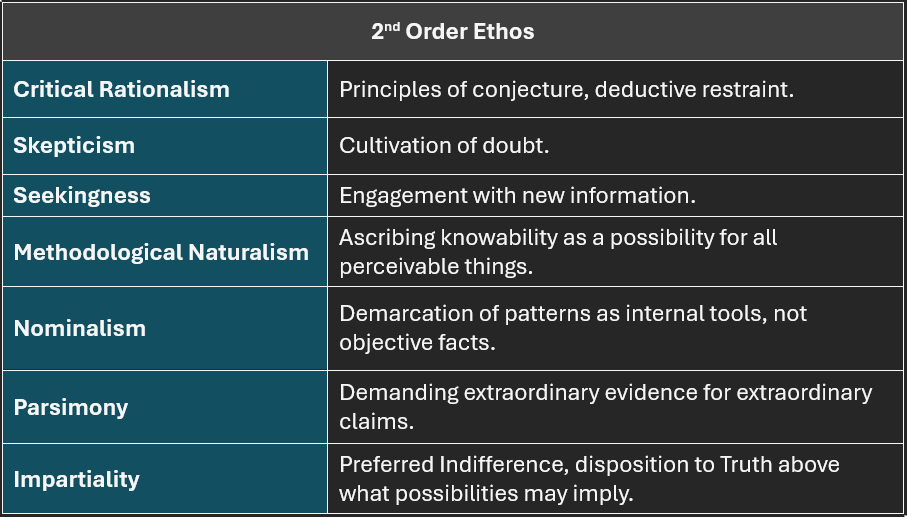
The Epistemology of Critical Rationalism
The Second Order encapsulates what comes to light as a natural consequence of viewing the world from this vantage, particularly consequences in terms of reactivity, pushback and counterwill that emerge from the tension of expressing values in a world that contains frustrations, such as heuristics, biases, desires and passions that can immerge as self-defeating. Ethos can be seen as regulation, pairing externalised procedures and processes to overcome faults in perspective-forming.
The Axiom of Knowledge
The Axiom of Knowledge is the idea that, in a theory of knowledge that sees knowledge as the form and expression of physical reality in mental space, knowledge is valuable, and you want as much of it as is possible while going after any other aims.
When you believe in something, you are inviting it to live inside of your head, and the more ideas you have in your head the greater the odds that two of them will directly contradict one another. When opposite statements meet, they cancel each other out, a bit like 0 + 1 - 1 = 0. This doesn’t mean a solution can be found by introducing a difference in some other demarcated area, such as ‘at a different time’ or ‘in a different place’. Once statements are made specific enough, they have a negation or opposite which cannot be true at the same time.
If you are trying to maximise the information that you have, you therefore need to filter out the negatives (‘untrue things’) before they can live inside of your head rent-free.
A simplistic solution is to hold several consistent beliefs and then never challenge them with new information. Or simply exercise doubt when looking at new information but never when looking at the information you already have. Unfortunately, this sort of thing tends to lead to local optimums where you can’t extend the knowledge you have beyond a fixed point, because you are being held back by one or more untrue beliefs. For this reason, we can say that maximising gains in this value requires globalised optimums, or Seekingness, where information is consistently sought out.
The Lemma of Doubt
To prevent local optimums, we can state that all beliefs may prove untrue and must be doubted. Even the ones that are already in your head. This leaves you free to ‘swap’ beliefs, maximizing the amount of consistent knowledge you possess by looking critically at all information, exercising self-doubt, challenging any signal entering your brain and all the signals currently inside of it.
Doubt is sometimes vilified as a hurtful emotion when compared with trust and faith. And it is perhaps true to say that everything you feel is not of the world but is your response to it. Impartiality as an ethos states that there is no full guarantee against the failure of long-held beliefs.
Instead of partiality to beliefs, what doubt offers is exercise of the love of knowledge, the attainment of delocalized optimums.
The catechisms of the ethos:
· Of all the things I believe, what are the odds all of them are true?
· So, which of the things I believe aren’t true?
· So, which of them can I trust?
The Principle of Conjecture
The Lemma of Doubt must apply equally to all beliefs, and that means necessarily questioning fundamentals, such as axioms, values, and principles. For this reason, belief is provisional, not absolute.
The word that describing a belief in this way is ‘conjecture’. This is putting thoughts together in configurations which suggest that a thing ‘could’ be true, and is being treated as a hypothesis. Hypotheses are open to challenge, seeking elimination through the discovery of contradictory evidence. After rigorous exploration of the doubt in a conjecture, it remains a conjecture but graduates from a hypothesis to a theory; a body of multiple hypotheses on the same subject that formalise it with laws.
The Praxis of Deduction
In accordance with the Axiom and the Lemma, there is a need to regularly embody their principles through Deduction.
This is a methodical process:
I. Conject that something is true.
II. Think of all the things which necessarily ‘must’ be true for the conjecture to be true.
III. Separate out things which sufficiently ‘may’ be true for the conjecture to be true.
IV. As you gain information, check if your original conjecture, some sufficient parts, and all necessary parts are still consistent with the added information.
V. If they aren’t, throw out the conjecture.
VI .Check the conjectures that you are holding onto regularly.
There are a couple of hard parts about deduction:
i. Remembering that a conjecture isn’t a fact, and looking for any true reason to drop it.
ii. Imagining ways that sufficient parts may replace necessary ones. (recognizing when necessity is really sufficiency.)
This is why the seemingly redundant point VI is so important. Often after going through all the trouble of gathering conjectures, we keep some of our conjectures without realizing that they were only there because they related to some other thing which has since been dismissed, or maybe that we are holding on to a conjecture long after it has been proven false by other information.
We can, of course, build some conjectures on top of others, though doing so is risky because we must keep them in separate branches, paying careful notice of which things are connected and which are separate.

Materialistic Demarcation
The above epistemology does not necessarily deal with physical things, but can more appropriately be termed a language of thought, or grammar of thought, which requires knowledge to be expressed in a particular format to be considered as valid to the thinker. It could just as easily be applied to a set of statements with no physical origin as to ones which are claiming to make actual reference to the mechanics of reality.
The Materialistic Demarcation, or Methodological Naturalism, is the idea that when we are approaching knowledge about the physical world, this knowledge must be expressed in a Language of Thought and subjected to the same system of testing as knowledge in any other domain.
This is not to claim that a Language of Thought describes everything that exists. It is only an acknowledgement of the constraint that when working with a human mind, all that one sees and experiences is trapped within the framework of things that can be expressed as thoughts, and so not to attempt to ‘fit’ the inexpressible within a formal system that will fail to describe it.
This is to say, what cannot be thought cannot be known, and consequently is not within the domain of knowledge. When thinking about unknowns, the method that is inevitably to draw comparisons or analogies to the known, to ‘materialise’ ideas. In keeping with maximising knowledge, it thus becomes imperative to test claims through material, not through immaterial methods, or to confuse material analogies to the immaterial with the immaterial.

Measure, Quantification, and NOIR
A measurement is any reduction of uncertainty, what we can think of as ‘sampling’ something to obtain a small snapshot of information about what exists beyond us. Information, similarly, is any difference that makes a difference, or anything that can exist in two possible states, existing in one state.
Measurement subsumes quantification, but is not restricted to it. Quantification can be thought of as using scales and spectra to declare a relationship between differences. But measures can also be done in other ways using the NOIR methodology:
Nominal :
Assigning a label, category, or ‘word’ to a thing, to state that it belongs in that category.
e.g. ‘Hot’
Ordinal :
A statement of specific relationship between two categories, such as <,>,=.
e.g. ‘Hotter than yesterday’
Interval :
A statement of degree, whereby quantities are introduced to express a relationship between members of a set.
e.g. 24° Celsius
Ratio :
A stronger statement of degree relating all things to a fixed ‘0’ point.
e.g. 297.15 Kelvin
The importance of NOIR is to introduce the idea that measurement is neither fine nor fuzzy by nature, but has degrees of accuracy; measures exist at a level where they can be used to navigate the world, but do not express absolute truth. Nominal and Ordinal measures are Qualitative, saying things in words or meaningful distinctions that can be considered roughly the same as ‘thinking something’.

Nominalism and Metabeliefs
Legacy of Mind adopts the position of Popperian Nominalism. This is a position that declares we cannot declare abstract things to have any independent existence (essence, form) separate from thought, but that abstractions are rather the product of mind and a convention or tool used to simplify thinking about complex, intangible things.
Because measurement is ‘in name only’, we can say that Ordinal, Interval, and Ratio measurements describe patterns which are themselves Nominal, not to be thought of as existing outside of categorical difference or being, ultimately, statements of belief.
This follows on the application of predicate logic, that numbers can be expressed as infinite sets with relations to each other. In other words, all quantification is qualification, but there is qualification that is not quantification, and both are valid means of measurement.
Patterns, rather than existing in the mechanics of reality, must always be thought of as simplifications taken up to explain something vastly more complex than they appear at face value.
Additionally, nominalism advances the idea of the categorical demarcation of beliefs. This is a general classification of metalevels. You can have:
What you believe
What you believe you believe
What you believe you believe you believe.
… and upward ad infinitum.
So in this sense, there are worlds (demarcations) that class whether a more direct or indirect conjecture is being made.
World 1: Conjectures about physical reality.
e.g. ‘I believe the grass on the lawn is green’
World 2: Conjectures about experiences/beliefs, in the self and in others.
e.g. ‘I believe that my eyes are working as normal when they tell me the grass is green.’
‘I believe that Susan believes that the grass is green, because she says the grass is green’.
World 3: Conjectures about entailments, theories, ideas beyond subjectivity.
e.g. ‘I believe in colours, I believe in a system of individuation that makes Susan a distinct subjective being.’
This demarcation of metabeliefs is useful in that it establishes sources of belief, parsing them in a way that does not jump from uncertainty to certainty. For example, it is uncertain and unprovable whether other humans have internal processing or whether they are philosophical ‘zombies’ acting in an intelligent way by all outside appearances.
All that is provable is the behaviour, and so by parsing the behaviour in terms of World 2, the ultimate truth can remain uncertain while functionally having a correct way to interact with the world.
The basic idea of this is never to assume more than you can see at face value, and to recognise face values can imply multiple possible deep complexities which may be believed in and acted on proportionately, which is to say, in ratio or rationally.

The Principle of Parsimony
Falsification is a necessary consequence of methodological naturalism, that it is not possible to positively gain knowledge of what is by adding facts together (due to the Principle of Conjecture), but it is possible to eliminate possibilities by finding evidence contrary to the conjecture. Pseudoscience, or pseudoknowledge, conversely is anything which can ‘possibly’ exist concurrent with the conjectures that are currently put forward.
When it comes to assessing possibilities, parsimony is the requirement that the more extraordinary the conjecture is, the more evidence is required to test it. This is coupled with the mathematical principle of Occam’s Razor, that the simplest explanation that exists concurrently with all conjected facts also has the greatest probability of being true.

‘Ethics’ in this sense refers to a person’s relationship to their surroundings, both its object and persons. It can be summed up as avoiding the impression of knowing things that are uncertain. The wider realm to which this is an influence is in seeking consent, acknowledging others as complex and distinct beings, regarding the self as imperfect.
To an extent this follows The Golden Rule to ‘do unto others as you would have them do unto you’, with the understanding that when a person is modelling others, the closest point of reference is their own self and mind.
It must, however, contain the additional proviso: ‘Unless they ask you to do differently, in which case make reasonable accommodations for the difference’, in the understanding that the closest point of reference is not going to be automatically correct.

the Third Order
The Epistemology of Science
When Critical Rationalism (or some other variety of Postpositivism) is applied to ecosystems and social groups, the behaviour of the group changes due to game theoretic strategies whereby values attempt to optimise in an environment where divergent intentions are at play. This means that rather than pursuing truth in isolation, truth-seeking is done in a group, in a way which enhances truth by ensuring communal regulations are in place to calibrate and prevent bias.
This effectively means that, for Legacy of Mind, the aim is not just to learn truth to the detriment of others, or with no concern of others, but rather to get as many people as possible to pursue mutual intentions.

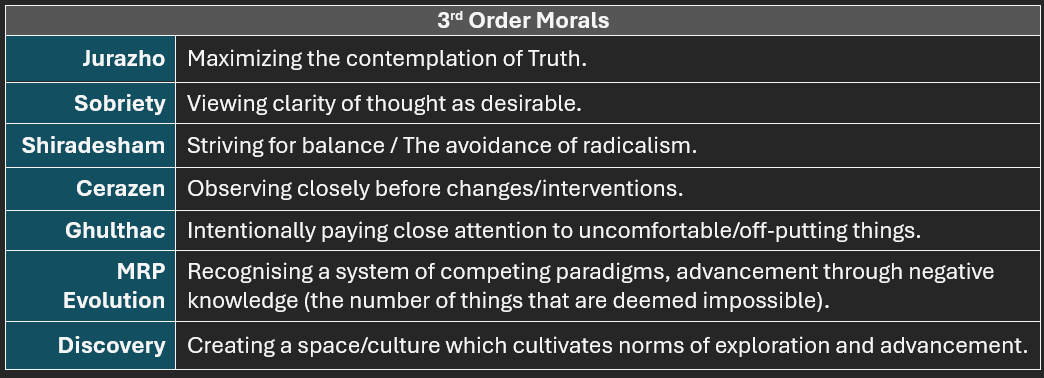
Jurazho: Impulse toward Truth
A moral imperative which can roughly be thought of as ‘honesty is the best policy’. It is an acknowledgement that thinking about true things is the least agitated state of consciousness, while falsehoods bring about discord and insanity. Effectively when modelling lies/deception, the same resources are used to compute two parallel realities, one with the truth and one with the lie. This detracts from the ability to more fully pursue truth.
Further, it is the belief that the way truth is classified must also be correct:
Truth is treated not something reachable by senses, but as an external reality. Truths can be thought of, but cannot itself be held as a thought (just as you can think of a table, but you cannot think a table). Thus, thoughts are only ever approximations of truth, and they never actually express physical reality 1:1.
Jurazho’s main precepts conject that if truth is in an external objective, then closely modelling it is a group effort. Mental barriers (biases, fallacies) exist when one person contemplates Truth alone, and so its pursuit is by nature a group activity.
The person who wishes to contemplate truth must offer truth as they see it to expect the same in exchange. To do otherwise, treating truth as zero sum, causes an unnecessary frustration in which parties attempt to gain knowledge while spreading deceit, ruining communication as a method of learning.
Treated as external, Truth cannot be diminished through the spread of falsehood. Jurazho is ‘Maximising the contemplation of Truth’ in that what is lost or gained is the extent to which the mind reflects the Truth present in objective reality.
The Jurazho doctrine states that Sanity is Happiness, a notion which translates to Sobriety. In Jurazho, pleasure that stems from untrue things is like a destructive, addictive illness, offering short-term release even while it decays the body and its awareness of all things outside of the lie.

Shiradesham: Balanced Temperament
This is a direct position against ‘black-and-white’ mentality, maintained in favour of nuance. It is the precept that, in situations of great complexity, complexity should be the excuse for maintaining the status quo or otherwise returning the system to a steady state. It is the deduction that balanced behaviours, which resists any form of radical action, serves best in the long run by avoiding overshooting by margins large enough to cause harm through error.
Occam’s Razor should not be confused with the belief that things are necessarily simple, as explanations must still account for all the evidence. In cases where the number of composite elements are many and diverse, the simplest solution may be that the emerging structure is complex.
‘Obvious’ black-and-white simplicities arising from complexity should be treated with skepticism. This does not mean wholly avoiding the study and implementation of radical positions, but rather Shiradesham counsels that radicalism must never upscale to the point where it is the main mode of operation. The small, precise implementation of radical action is still regarded as useful, whereas any radical action which destroys the tolerance of and ability to adopt other modes of operation is not to be desired.
If the status quo is a radical position, that too should be judged by its stability, because there is a high likelihood that it is producing frustration and is better overturned.

Cerazen: Observing closely before Intervening
The immediate position in facing something new is the outside view that, due to the nature of mortal subjectivity, what one is encountering is to a larger degree unknown rather than known. This means that in its current state there is something sacred, or not to be touched or interfered with until it is explored.
‘Sacred’ does not mean ‘unstudiable’. It means that efforts should be made to preserve or protect an anomaly, and that the destruction of an anomaly, or its reduction down to composite material elements, must be avoided.
The aim is not to worship mystery, but to engage with mystery, to recognize the unknown and convert it to the known. Nothing is considered as Cerazen forever – once a thing is understood, it may be used, broken up or replaced with something of greater value. But to destroy the unknown, or to treat the unknown as though it is known, is a terrible thing.

Ghulthac: Overriding Negative Reinforcement
Roughly equivalent to ‘staring into the void without nihilism’. Ghulthac is the moral need to study disgusting or repellent things in the pursuit of truth, recognizing that mortal and subjective notions of beauty are aligned to the wider beauty of objective, immortal truth.
This is an important practice because of negative reinforcement in perception – often we are conditioned through pleasure and pain to avoid the mere sight or experience of things associated with pain or discomfort, due to the close correlation between ‘observing’ a thing and ‘engaging’ with a thing. By highlighting the difference between these two, noting that observation is separate from engagement or suffering, we are better placed to learn what we can.
Ghulthac focuses on corrective bias toward recognizing ‘hard truths’ to consistently make oneself aware of reinforcement. Ghulthac includes discouraging nostalgia and the aggrandizement of the past by giving as much attention to the negative as to the positive, and resisting the worship of antiquity for antiquity’s sake.

EVOLUTION:
A Metaphysical Research Programme
A critical feature of engagement with learning is the adoption of natural selection not as a biological or genetic theory, but as a wider system of understanding beliefs and the relationship of beliefs to one another.
In the ecology of mind, we can say that there are ‘niches’, or spaces open to beliefs, and that each niche is only large enough to sustain a single difference, or statement of truth, which at any time is in competition with its negation. Each statement is subject to selection pressure, in that either it or its negation survives. This pressure may be resolved through a decision, but such decisions are always open for review. Means of review vary, but typically resort either to consideration of the Grammar of Thought or to correspondence with sensory feedback from an external reality.
Each filled niche opens new niches, as statements of belief about belief, or metafacts, which are functionally part of an incomplete hierarchy (because they are infinite). Determining the level of meta for a fact establishes whether it represents reality or possible realities, or the set of impossible realities.
This means that niches of belief quickly outpace the limits of mortal subjectivity, in that only a small quantity of memory is available to hold/store beliefs. Rather than simply competing with their negation, beliefs compete for relevancy in the larger system.
Beliefs in this system develop survival strategies, which can be thought of as related structures that either promote continued belief in them or their seed (axiomatic statements which are taken as fundamental without explicitly encoding where they lead). Survival strategies may include things like natural correspondence, instrumentality, utility, or beauty.
Legacy Seeds
The seed method is favoured as a symbiotic structure of ideas to the aims of Legacy of Mind. This is in strict accordance with the idea of strongly universal principles as well as informational uncertainty, in that seeds are from universal domains (core ideas, roots, formal structure), while specifics are likely to change according to circumstances in play. By populating the mind with seeds, they can grow out to understand local conditions and then wither back when context changes, so as not to become blind to changes in context.
This can be seen as starkly contrasted to Feed strategy, where a single source dominates, grows out, and extends rules and protocols over all that it encounters. Legacy of Mind is not an attempt to subject everything to a major system of strict laws, but rather to enforce the smallest possible number of laws. This is reflected by deduction’s efforts to reduce existing laws to expressions of simpler ones, and to be sceptical of ‘rules’ that do not reduce in this way.
In short, ideas evolve and adapt over time, but the contextual framework in which adaptation occurs remains stable.

The Disco Movement
Disco, discovery, or Veritas Quo is an envisioned accompaniment to Legacy of Mind that explores what it means to live by its principles in the localized context of the 21st century. As a lifestyle, it is an expression of Legacy of Mind through self-improvement and long-term optimism.
It can broadly be seen as a branch of posthumanism, blending cyberdelics and futurism into a culture of exploration, skepticism, and truth-seeking as a defining trait of identity expression.
Disco promotes:
Focus on personal growth ahead of the ‘correction’ of society, emphasis that asserting self-perfection and local integration of values will have its own impact, while being met with less frustration.
Use of cyber-education platforms as a means of entertainment. Prioritizing learning over certification, and understanding over honorifics.
Use of non-harmful nootropic agents to kickstart transcendental recreational experiences, as opposed to their use for 'exam cram'. Care for the human body, health and sobriety.
Self-investment, and identification of the self as more than a body and psychology. Establishment of community, cultivation of 3rd spaces, the creation of art and expression of ideas.