OXFORD MAKESPACE: OUTGROW THE SYSTEM
I am musing a bit today after going to see Professor Kate Raworth present the documentary "Outgrow the System", and the ideas held and shared in the Oxford Makespace. Among the more usual calls to eco-Marxism and communism, there were real gem ideas that made me think more positively about the environmental movement's ability to affect real change.
I tend to get a gut-horror reaction to people decrying capitalism, because I use the word differently. To me 'Capitalism' is the countercultural movement away from 'Mercantilism' and away from the idea of wealth as a zero-sum game with winners and losers; that, employing Enlightenment era virtues, research and technology are investments made that iteratively improve society when ideas are allowed to spread, and that success or failure when employing technologies is a selection pressure that leads to their excise or embedding. That far from monopolising or centralising power, these investments are what allow civilisations to thrive.
But of course, when people decry capitalism, this is not what they are referring to. What they are signalling resistance to is the continued legacy of Mercantilism, and its transformation to Corporatism in the modern economic landscape. Provided I put a conceptual Babel Fish in one ear, I can converse with other environmentalists and most of the economic left without frustration.
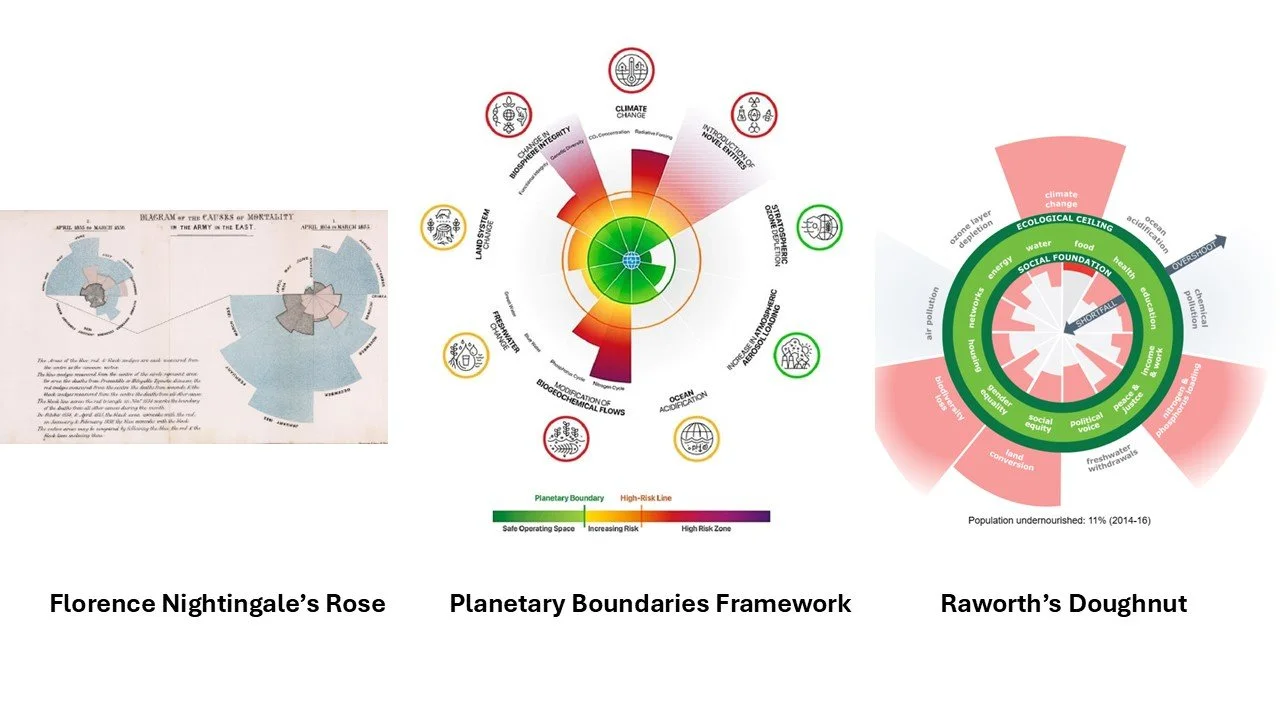
Professor Raworth introduced the Doughnut Model as an extension of the Planetary Boundaries framework, and it really is a wonderful data visualisation that I am surprised has not caught on more widely. It looks a lot like Nightingale's Rose but is not time-based. The idea is that 'externals' on the outer ring are driven by 'internals' on the inner ring, with either a direct or implied relationship between the two. And this is important for change management because it highlights what underlying social or individual needs must be met for external pressures to ease.
The Regrow the Economy documentary asked tough economic questions and provided stunning visuals and is worth watching. The central idea is that economics is, effectively, an abstraction designed by humans to manage the 'house' (planet), and where it is failing to do that, it is failing to correspond to reality. So, the model needs to change. It explores a number of real-world alternatives that are in practice and which look promising.
ECONOMICS & GAMES
The audience were great, too, in addressing their experiences and concerns. We discussed cultural modelling through education and games, particularly Monopoly and its origin in Elizabeth Magie's "Landlord Game". Many of us had that shared experience of frustration in playing Monopoly as kids, this idea that "this is how real money works and you have to learn to play the game."
I found it strange, though perhaps predictable for older attendees and more on-the-ground environmentalists, that video games never came into the picture. With 40% of the world regularly engaging with these digital models, it seems that one of the most important structures shaping our psychology, our relation to economics, decision theory, and metrication is being overlooked in favour of the 25% who play tabletop, even if some of them are considerably younger when they are exposed to the models.
When I think of the games that shaped my own thoughts of economics and ecology, I think of The Sims, Anno 2070, Spore, Reus, Warcraft III, Frostpunk. That there are sometimes dangerous axioms baked into digital models, like the ability to tap lines of infinite resources, or that wealth can only be spent to advance a military-industrial complex. As Raworth pointed out, Monopoly survived in its current form because competition is 'fun', appeals to part of us that equates victory with having the biggest territory.
What I sort of hope, quixotically, is that video games can retain a function as an abstract territory separate from reality - that is, an intentional fantasy. That rather than treating them as an exemplar for real-world behaviour, games become a place to act out the most destructive aspects of our wants and desires (irrationalities, like doing dangerous or energy-intensive things). That a conscious suspension of the rules of reality becomes the artistic forefront of the digital realm. That its chief benefit is that it is 'not' the real world and removed from the devastation of real-world consequences.
So, what do we want these different sorts of games to teach? All experiences are education. And the framing of games, the objectives one chooses for the player and the choices they allow shape our idea of what is possible. So, I would highlight a few things that we want to include in games intended to inform economic and environmental thinking:

- You can set your own goal at the outset and change it later. There are many paths that are considered as 'victory' and they are mutually exclusive.
- Resources are finite. Creating something new often means recycling the resources that you have and spending them in a different area. It is possible to waste resources if they are mismanaged.
- Assets require maintenance and restoration. You need to save resources for reinvestment if you want to keep things running.
- There are 'hard' rules and 'soft' rules, and you can change the 'soft' rules by taking actions within the game, rather than doing so by going to a meta-level outside of the game.
- There is no single metric of performance that matters beyond all others. Your lowest metric becomes a weak point, with increasing pressure when it is ignored.
- It is not Player-versus-Player, and not Player-versus-Environment, but a collaboration of players with their environment to face a maladaptive System.
We are not all game developers, but we are all consumers of the models and games we use and share with our friends and children. At the very least, when engaging with games we should be critically assessing whether it meets these criteria, and invest less attention in the games and models that do not.
METRICS
Another important question raised by the audience was around Measurement. Particularly, the idea of money as a single value that is meant to capture power, wellbeing, progress - and how it fails to do so. At the forefront, the GDP model of measuring governmental stability and power was the subject of criticism.
In light of this people are looking to alternatives. "Gross National Happiness" seems favourable as one metric. Biodiversity and Air Quality are examples of others. A third, and one I am hesitant about, is Social Capital.
A large part of this story - and why I tend to think of my perspective as anarcho-capitalist rather than Libertarian - is that money is not representing what it is supposed to represent. In the ideal world, the ones Libertarian thinkers often live, money reflects decision-making ability, and the better decisions you make, the more of it you have. So, all that is needed to end monetary distortions is to maximise personal decision-making ability.
But we can see that this is not the case. Often the wealth and opportunities we have come from where we were born and into what family, to physiological and psychological constraints. Often it comes down to chaos, a gambler's luck, or ruin in the face of unimaginable complexity. Our environment is not equally distributed. So, the concept of money as a decision-making metric can at 'most' be true on aggregate.
What we see when the foundations of what we think of as 'money' itself are unsound by their exclusion of environmental variations, and with no control for handling error correction, is a metric which fails to model reality to any degree of fidelity. So, the idea that we move away from money and finance as measures of wealth seems to be a mode of dealing with an ingrained metric that seems very unlikely to change.
I love money. I like that we have an underlying accounting system to energy transfers trying to keep track of the 'flow' of potential and work. But I also am mindful that it is imperfect and needs restructuring if something as vital as decision-making ability / intelligence is going to be quantified to any degree of accuracy.
It is unlikely that new economic metrics are going to be politically initiated from the top down. But you can use your own metrics to understand the world. What I would highlight as important metrics I use are these:
- Uncertainty. Particularly, if we are attempting to calculate system stability we should take as a metric the rate of change within a system, how fast biomes are transforming or cities are growing. Calibration, the awareness of our own uncertainty and the risk of our metrics being inaccurate, places Applied Information Economics at the heart of any attempt to model. The higher our uncertainty is, the more difficult it should become to push for changes and interventions that do more than attempt restoration to a prior state.
- Inefficiency. Particularly the idea of generated waste, wasted time, and wasted potential. Quantifying waste allows us to devote more resources to waste management, as well as to identify harmful consumer and cultural practices that are being allowed to thrive when waste is ignored.
- Eurekometrics. Calculating the rate of gain of technology, knowledge, and understanding. These are measures of human power to affect destiny which are quietly humming in the background of human culture, when really, they deserve the role of the lead. We can think of these as 'Science Points' accumulated through the number of published scientific articles, the number of university graduations, the number of patents filed, the goodput of accessed scientific data on the internet.
Much is said of the 'military-industrial complex', a zero-sum perspective in which competitors are other humans and nations. Norbert Weiner pointed out that militarism has a negative effect on scientific endeavour, that it defines 'intelligence' in terms of information you have that your opponents do not (or that they do not know you have), and the consequence of this is corporate secrecies, layered access to truths, deliberate misinformation. Yet when we step outside of this model, when we do not draw up battle lines against the knowledge of competing academics or nations, and instead appropriately fight our own ignorance, what we achieve on the societal level is quite different to the 'military-industrial complex'. It becomes more in the nature of a 'research-development complex', bent on creating and cultivating cultures of understanding.
Obviously, there are other important metrics than these. Though when I am personally trying to assess the state of the world and my feelings about it, I try to get a feel for these instead of GDP.
SOCIAL CAPITAL
Toward the end of the evening a question was raised by a woman from Germany, who told us about a friend who lived in Hungary, experiencing the devolution of a democratic state into kleptocracy and authoritarian rule. There was a strong feeling in the room that authoritarianism and its increasing presence was linked to corporate control, that businesses as economic powerhouses were appealing to an authoritarian ethos to subvert the checks and balances of democracy. And if there is ever a bad concordance between business and politics, it is between the plutocrat and the kleptocrat, one feeding the other to assert their power in a drama of representative democratic statehood.
She asked if there were others present, from various parts of the world, who had different experiences than those widespread in England as what might more widely be termed "The European Model", though obviously not uniform across Europe in nature and expression. The European Model is the widespread entanglement of finance and policy into the commercial tangle of 'neoliberalism' that predominates in nation states around the world, and which I think rightly fears degeneration into a kleptocratic state.
It was late and I had not much marshalled my thoughts into a suitable reply, but it did make me think quite a bit about my experiences living in South Africa, and what might be termed "The African Model" of capital, debt, and investment, again obviously not uniform across Africa in nature and expression. This comparison is something as different as Urras and Anarres, with striking parallels.
THE AFRICAN MODEL
South Africa is as neoliberal as most places in the developing world, but it is also sidelong to the older architecture of a society that has coped with disease and disaster through Social Capital. While money plays a significant role, there is a more key role played by family and family obligations. The size and strength of a family and its connections is literal life force, a vessel for ancestral activity which, for many, represents the connection to a broader spiritual world through ancestor veneration. Your family, particularly your elders, are upheld as a connection to a greater spiritual existence which persists beyond death. The ancestors are responsible for the protection and fortune of the living, and, because they will soon ascend, the appeasement of elders and parents is important in making sure that this spiritual connection is strong. Respect paid to one's elders is a debt paid in advance for their support after death.
European culture has crude analogies that come close to this. If we think about inheritance as a kind of good fortune, and the threat of being cut out of a will as a curse, there is a Social Capital game afoot in the markets. Systems of enchantment like reputation and honour hold and shape Social Capital, conferring status and potential through networks of human relation. Just as money is only as good as the principle that people accept its coinage, Social Capital derives its value from trust, from a shared belief in a person's power or ability.
The African Model is dense with Social Capital, and peculiar in its debts. Resources and attention are owed to ancestors, and elders. Your own reputation depends on your continued payment of these debts. There is a tension between what you keep for sustaining your own life, and the money you send home to your family. It is crass but perhaps accurate to say that there are cases where families colonise their children, invest in children and their education with the expectation of extraction, that the elders will be looked after when those children come of age. The debt is not a written contract, but it is very real. It has reputational and spiritual consequences if it is ignored.
The beauty of the African Model can be seen in the idea of 'intelligent capital'. Money, in the European Model, is static and dumb. It requires an actor, someone to manage it financially, to make decisions and push it around. This creates significant mismanagement when money 'rests', when it is not flowing to points of loan or reinvestment, but kept in reserves, stores, and endowments that are not fully optimised, like land sitting barren and unworked. Its benefit is that it is not 'lean', there is room for luxury and idleness, and spending vast amounts of resources on a single goal.
In the African Model, it is possible to draw an object level equivalency between 'money' and 'people'. That when a level of resources is reached, the smartest thing you can do is have another child, invest those resources into a living, intelligent being that protects its own endowment (works to self-sufficiency, survival), while paying back the ancestral debt (providing dividends), and reinvesting (self-improvement). From the outside, to the European who thinks in terms of monetary stasis, what this looks like is a poor family with lots of children. From the social capital perspective, this is a frugal family with a wide investment portfolio. Investment of this time can be very direct, with systems like Lobola (cattle dowry) demonstrating the correspondence between the value of a marital connection with cattle or cash, as a deposit that shows gratitude and ongoing commitment to interfamilial bonds. Rich, powerful individuals do not always live in the biggest houses. They have lots of children, and many wives, and protect and care for their families.
DECONSTRUCTION
There is also a notable weakness in an inverted population pyramid. When there are more elders than youngers, the young feel increased pressure to look after the old, a bit like the problem Europeans experience with 'social security' plans. This means that this model, like the European model, drives population growth.
The system of course went horribly wrong when the European and African Models collided, and Europeans began to 'buy up stocks' of Social Capital without the infrastructure of ancestry and reputation required to sustain it, turning to immense cruelty as a means of control, and using humans as 'disposable income'. Slavery in this sense was a perversion of African economics, understanding human profitability without concern for human worth, or the network of social connection underlying the entire system.
Slavery was, of course, just one threat to the African economic model. Another major threat has been the persecution of ancestor veneration, attempts to replace the African spiritual landscape with foreign religions. This serves to weaken the Dividend aspect of economics; the system of debt to elders and spirits. The debt system, justified or not, is responsible for the sustainable 'purpose' of the economic structure. Release from that debt leaves the elder in extreme poverty, and the younger sceptical about investing in children from whom they will not receive their own dividends. These religions have other attractive principles, such as charity and communal care, but they are not the complex system of Social Accountability that keeps the social economy viable.
A second hard-hit area has been self-investment, the idea that individuals can improve on their situation with skill and striving. Deliberate systems of disempowerment like Apartheid wrought havoc by denying the ability to self-improve, but so do imported Values, the cultural symbols and signs of what power and success look like. A bit like the problem of universal metrication leaning into a single metric of success, the disempowerment of Africans as individuals and individuals-in-community has been the result of consumerism's focus on luxury, land, and leisure.
A system of Social Capital does not look good under pressure, and this is where I think there is a favourable comparison to Ursula Le Guin's Anarres (from The Dispossessed). Africa, like Anarres, has in Social Capital the similarity of treating humans and intelligence as more precious than metal or salt or jewels, so precious it is worth risking more deaths to obtain more lifeforce. The distortion of this is equating human value purely with intelligent labour, seeing humans as organs in the body of a corporeal leviathan. In this state, reputation and community become the whips and rods that emphasise ancestral debt over individual freedom. Like a corporation chasing dividends above stability, a community that makes sacrifices of the life and liberty of its members, for the sake of 'communal good' or the interest of a majority or moiety, is again failing to model decision-making and value correctly.
We see this when uncles demand outrageous dowries, or when university students have the pressure of selecting majors that will support their entire family. We can see it in nepotism, where businesses are peopled with loyal family members that are expected to echo the voice of their patriarch. And we can see it in the breaking of individuals who crumble under the pressure and drop out of the system entirely, losing all moral centre out of the association of morality with the spirit of community.
A lot of this is due to the meddling of the European Model, the conflation of wealth with possession. But it should also be noted that there is a role to be played in the kind of work we are engaged in on a societal level, that the value of unschooled labour has decreased with automation and the 'low hanging fruit' of science and invention has mostly been picked, leading to a concentration of value in highly-educated individuals with tools and resources. We have moved past a point where human quantity is enough, and successful investment now demands higher input and output per human individual.
REINTEGRATION
It should be noted that the pursuit of Social Capital is still capitalism, still bound by the same dangers of consumptive growth, exponential change, waste generation, and Return on Investment. And so, when adopted more consciously, it should not be expected to lead to different conclusions than material capital does. What it does do is stress aspects of how we may structure social relationships to more favourably generate wealth.
These may feel at times to be matters far from economics, or environmentalism. But if we are straying from standard measurements of economic output and environmental health, we will need to incorporate ideas outside of the field as it is defined.
Something along those lines is my answer to the question, "what models exist in other countries, other parts of the world?". I was not born in South Africa, but I grew up there, inhaled its culture deeply and metastasised its principles. And what they tell me is that there are three ways eco-environmentalism needs to address this aspect of resource management:
- Provide an incentive for social investment that returns in a person’s old age. This cannot be a blanket social security, but rather a specific, individualised reward for cultivating strong relationships, procreating, and nurturing. For example, if social security could be modified by the number of registered children that have not declared legal emancipation, or by communal endorsements. Or more personally, structuring wills and inheritance in such a way that the remaining wealth of elders will not go to people who have not provided for the elderly, or to siblings who have not done the same.
This could also be tied to memorials and spiritualism, connection to the afterlife. Efforts should be made to assist the collection of recordings, statements given to later generations that explain who an ancestor was, what they hoped to give to future generations. Families can do this by themselves, and there is potential for communal libraries of these interviews or 'ghosts' to be collected, that may be helpful in cultivating longtermism and a feeling of social connectedness.
- Ensure the separation of human value from the value of 'current productive output'. Human rights and social welfare are desirable in this sense because they aim to treat people as an end, rather than a means to an end. This critical distinction is necessary to avoid human possession, and the confusion of a human with a smart machine. In a personal capacity, I often think of the words of Frank Herbert’s Orange Catholic Bible, “Thou shalt not create a machine in the likeness of a human mind,” and the multiple ways that this dictate can be interpreted. When considering people as a means, a tool, an agent, we slip into that place of creating a machine out of a human mind.
It is difficult to set aside strategy, economics, and accounting when you are accustomed to computation. Yet this is often what is required when dealing with the complexities of a human being. Thinking of people and connections as ‘Social Capital’ is a sure path to becoming possessed with the mechanics of power and control. Instead, as a gestalt principle what we can do for others need be in the communal frame of bonds and relationships, that what is created by the investment of energy is not a transaction necessarily, but a bond through which transactions become possible. They are not ‘our’ bonds or need to be bonds that lead to us. They are just bonds in a network we are a part of.
In the spirit of the Anarresti, “Free your mind of the idea of deserving, the idea of earning, and you will begin to be able to think.” Live life as though you are owed nothing and owe nothing but that which you choose to owe. Break bonds that create inequalities, weave ones that form reciprocations. Human value is only measurable by looseness, by a wide and flexible net.
- Crucially, we know that providing a social safety net is not enough to drive a healthy, productive social network. People also need to self-invest, to believe in themselves and their power to affect change. To this end, places like the Makespace, communities of art and craftsmanship, are going to be critically important as we move into an era where most 'productive' thought-based work is done by intelligent machines and their maintainers. Having a voice, sharing that voice, creating beauty, and making meaning is speaking the language of self-expression and improvement. A thriving economy in the context of social capital cannot be one of exceptional celebrity or 'winner take all’ but makes an intentional effort to divide the attention economy and make clear that power and fame are not the goal, quality is.
One way I imagine this could happen is through an internet of 'limited reach', where above a certain number of free views per week, viewers pay to access viral and high-spread content. A bit like an ad wall, but with better tuning and without the ads. A drawbridge.
In a personal and familial capacity, we need the same. No single source of truth or cultural identity. Active engagement with Making, and diversity in diet when consuming art and information. It is necessary to break out of the siren song of fame and celebrity, to see more than popularity as the measure of art, and of artists.
CONCLUSIONS
I left the Makespace feeling oddly hopeful. Professor Raworth made it clear that she found working with the UN and similar organisations attempting 'top-down' change management to be a dead end. Many of them may genuinely want change but are tied to the power they possess in the status quo, and how embedded ideas structure and shape the existing organisation. Instead, the idea of new businesses, institutes and initiatives self-designing against the norm seems to be a place where they can make headway towards an environmentally-led economy.
And this is, to me, what democracy and capitalism were always supposed to be about. Division of power, experimental models running sidelong one another in a state of friendly co-opetition. It feels like one of the ways that we move forward as an ecology to a kinder, punkier future.